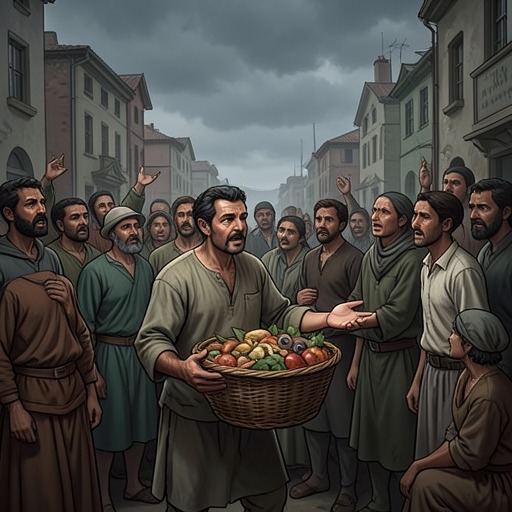
Feeding of the multitudes
Don't Leave God Alone: How to Get God's Attention, Remain in His Presence, and Even Change His Mind to Make a Difference in Your WorldFeeding of the multitudes is remembered not only as a miracle of provision but also as a revealing test of spiritual hunger. The crowds stayed when Jesus Christ supplied food, yet the book uses their response to show that a desire for visible blessing can be stronger than a desire to seek God through prayer.
The Miracle and the Crowd
The account is invoked through the statement that when Jesus Christ fed the multitudes, nobody left. The gathering included five thousand men, in addition to women and children, and the people remained around Him while their physical needs were being met. The scale of the crowd emphasizes the public force of the miracle: provision drew an audience large enough to become a collective image of human need and expectation.
The event is not described here through the mechanics of the food’s multiplication, but through its effect on those who witnessed and received it. The multitude’s continued presence shows how readily a crowd responds when faith is connected with immediate nourishment. Food becomes the visible evidence of benefit, and the people’s persistence around Jesus Christ demonstrates the attraction of a blessing that can be directly experienced.
Provision Compared with Prayer
The book places Feeding of the multitudes beside the scene in which a disciple asks Jesus Christ to teach the disciples to pray. That disciple does not ask to be taught prophecy, evangelism, or the performance of miracles; the request centers on prayer. The contrast identifies him as unusually hungry for communion with God, whereas many among the multitudes are portrayed as hungering chiefly for physical needs.
The comparison becomes sharper because the crowd remains for food but becomes smaller when prayer is called for. Feeding the multitudes therefore functions as a measure of competing appetites. Physical provision attracts numbers, while prayer exposes the depth of a person’s spiritual desire. The book’s argument is not that bodily need is insignificant, but that dependence on visible benefits cannot substitute for the hunger that seeks God Himself.
A Pattern Repeated in Church Life
The author extends the contrast from the biblical crowd to contemporary church practice. In the author’s pastoral observation, people readily attend a midweek pizza gathering, a fellowship meal, or a Super Bowl party, while midweek prayer meetings usually receive a smaller commitment. The same pattern that appeared around Jesus Christ is thus presented as recurring in congregational life: fellowship and food can draw many, but sustained prayer requires a more deliberate spiritual appetite.
This recurrence gives the miracle an instructional role. Feeding the multitudes is not treated as an isolated display of power; it becomes a reference point for examining why people approach religious communities. Large attendance may indicate interest in benefits, fellowship, or immediate satisfaction, but the book insists that the key to success in life is found in prayer. The smaller prayer gathering can therefore represent not failure of importance but a division between popular attraction and spiritual seriousness.
Hunger, Fellowship, and the Book’s Call
The book argues that prayer should not be motivated only by tragedy or emergency. A person seeking to rise higher spiritually must develop a hunger for fellowship with God, because regular communion and daily commitment are described as sources of safety. Against that standard, Feeding of the multitudes reveals the limits of a faith that gathers only when provision is offered.
The event ultimately supports a call to pursue God beyond what God gives. The disciple who asks to learn prayer embodies the response the book desires from its readers: not merely to remain near Jesus Christ when needs are met, but to seek an ongoing relationship with God. In this reading, the miracle’s lasting significance is the tension between a crowd enlarged by bread and a smaller company formed by prayer. The first demonstrates Jesus Christ’s compassion and power to provide; the second, in the book’s interpretation, reveals the deeper hunger on which spiritual life depends.